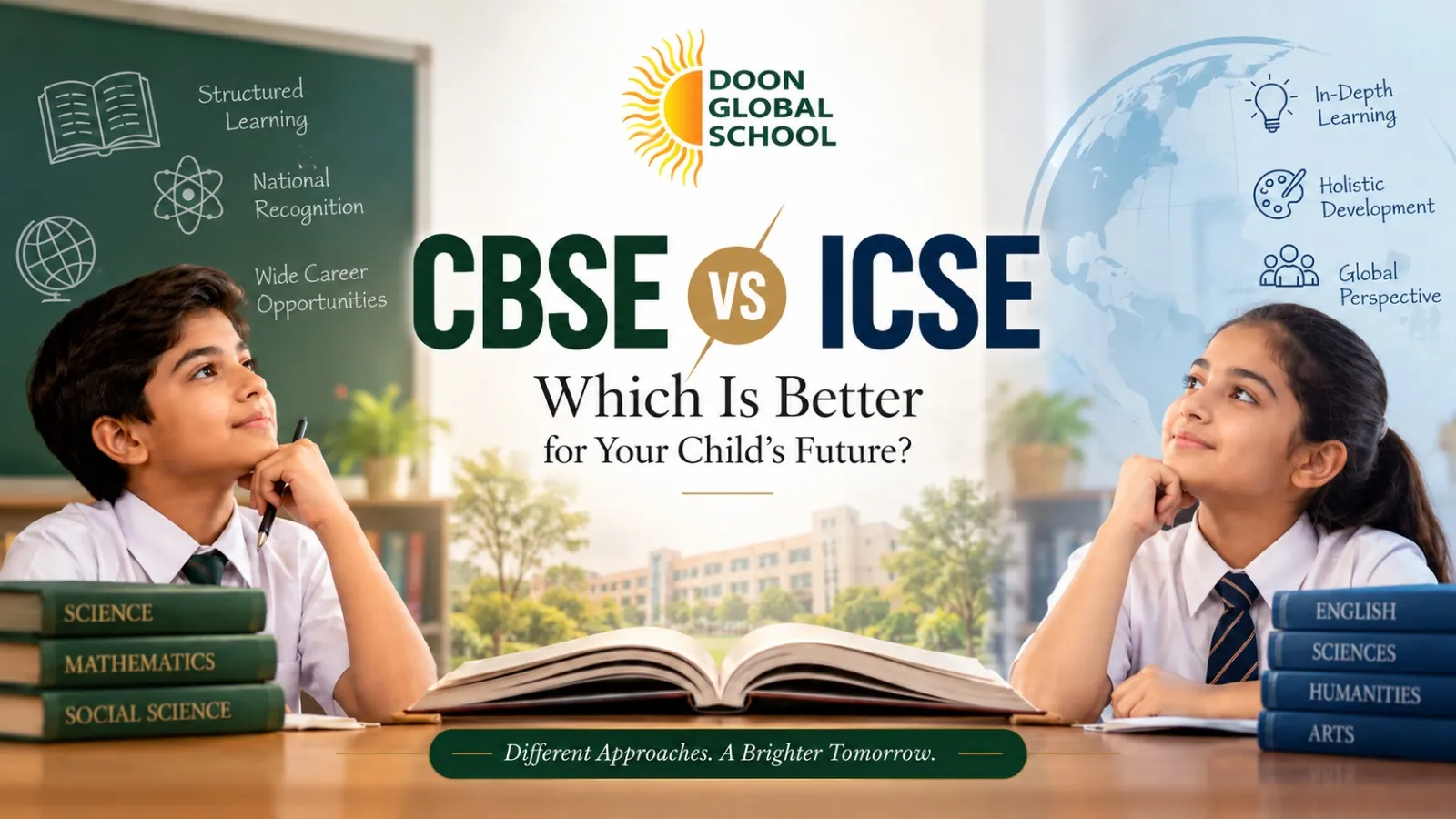
Ask ten parents which board is better and you will get ten confident answers. The honest reply is less dramatic and far more useful: CBSE and ICSE are both credible, well-established boards, and the better one is the one that fits your child, your family's plans and the school you are actually choosing between.
The Question Behind the Question
When parents ask whether CBSE or ICSE is better, they are usually asking something more specific. Will my child cope with the workload? Will this help or hurt if we move cities? What happens if she wants to sit for JEE or NEET? Will he actually enjoy studying?
Those questions have real answers, and they are worth separating from the board-versus-board argument that dominates parent groups. Neither council issues an inferior certificate. Both are recognised by Indian universities, by the Association of Indian Universities and by institutions abroad. What differs is the shape of the curriculum and the kind of learner it tends to suit.
What CBSE Is
CBSE stands for the Central Board of Secondary Education. It is a national board under the Union Government and the largest school board in the country, with affiliated schools in almost every district as well as in several countries where Indian families live and work.
CBSE schools follow NCERT textbooks. The syllabus is deliberately compact, structured around core concepts rather than exhaustive detail, and it is revised regularly. Because the syllabus for national entrance examinations such as JEE and NEET is drawn largely from NCERT content, CBSE students often find that their school work and their entrance preparation cover much of the same ground.
Assessment combines periodic internal work with the Class 10 and Class 12 board examinations. Question papers have moved steadily towards competency-based and application questions rather than pure recall, and CBSE students are expected to write answers that are precise rather than lengthy.
What ICSE Is
ICSE is the Indian Certificate of Secondary Education, the Class 10 examination conducted by the Council for the Indian School Certificate Examinations, or CISCE. CISCE is a private, non-governmental examination board, and its Class 12 examination is known as the ISC.
The ICSE curriculum is known for its depth of detail and for the weight it gives to English language and literature. Students read set texts closely, write extensively and are examined on comprehension and expression in a way that many parents value. Laboratory work, projects and internal assessment carry meaningful marks, so the final result reflects a year of work and not only a set of final papers.
ICSE also offers a wide subject list, including a strong range of arts, technical and applied options at many schools. The trade-off is volume: there is simply more content to cover, and children who dislike long written answers can find it heavy going.
CBSE vs ICSE: A Side-by-Side Comparison
The table below sets out the practical differences. There is no winner column, because the same feature can be an advantage for one family and a drawback for another.
| Aspect | CBSE | ICSE |
|---|---|---|
| Governing body | Central Board of Secondary Education, a national board under the Union Government | Council for the Indian School Certificate Examinations (CISCE), a private examination board |
| Syllabus approach | NCERT-aligned, concise and concept-led, revised regularly | Detailed and comprehensive, with wider coverage within each subject |
| English emphasis | Strong, taught as a core subject alongside other languages | Particularly strong, with separate weight given to language and literature |
| Subject choice | Streams and electives open up mainly in Classes XI and XII | A broad subject list, including applied and arts options, available earlier |
| Assessment style | Board examinations with periodic internal assessment; answers tend to be precise | Board examinations with substantial internal assessment and project work; answers tend to be longer |
| Competitive exam alignment | Directly aligned with the NCERT base used by JEE and NEET | Students sit the same exams and do well, usually after mapping their syllabus to NCERT |
| Availability across India | Very widely available, including in smaller towns and district headquarters | Fewer schools overall, more concentrated in larger cities |
| Transfer between cities | Usually straightforward because a CBSE school is likely to exist in the new city | Possible, though finding an ICSE school in a smaller town can take more searching |
Which Board Suits Which Child
Fit matters more than reputation. The two lists below are a starting point for a conversation at home, not a verdict.
CBSE tends to suit a child who
- Is heading towards engineering, medicine or another national entrance examination and benefits from an overlap between school work and preparation.
- Prefers a clearly defined syllabus with well-marked boundaries for each chapter.
- Belongs to a family that may relocate, since CBSE schools are available almost everywhere.
- Works better with structured, to-the-point answers than with long essays.
- Wants a manageable core load, leaving time for sport, music or other serious interests.
ICSE tends to suit a child who
- Enjoys reading widely and writes with confidence and pleasure.
- Is likely to move towards the humanities, law, design, journalism or the languages.
- Learns well through projects, laboratory work and continuous assessment rather than a single decisive examination.
- Has the appetite and the study habits for a heavier, more detailed syllabus.
- Is settled in a city where good ICSE schools are within reasonable travelling distance.
What Matters More Than the Board
Here is the part that rarely features in online debates. Two schools following the same board can deliver completely different experiences, and the gap between a strong school and a weak one is far wider than the gap between CBSE and ICSE.
Before you settle the board question, look hard at the school itself:
- Teaching quality. Ask about the qualifications of subject teachers, how long they have been at the school and what training they receive.
- Class size and attention. The student-teacher ratio tells you whether a quiet child will be noticed.
- Safety and pastoral care. Campus security, transport arrangements, the infirmary and a named person responsible for child protection matter every single day.
- Breadth beyond the syllabus. Sport, music, art, debate and clubs are where confidence is built.
- Communication with parents. How and how often will you hear about your child's progress, and how easy is it to reach a teacher?
- Practical fit. Distance from home, daily travel time, the fee structure and what it does and does not include.
Visit the campus. Watch how children behave in the corridors, not only in the room you are shown. Ask the questions you actually care about. A school that answers them openly is usually a school worth considering, whichever board it follows.
Where Doon Global School Fits In
Doon Global School is a co-educational CBSE school in Dehradun, affiliated to the Central Board of Secondary Education under Affiliation No. 3530108, teaching Nursery to Class XII with boarding for boys available from Class 3 upwards. Class XI students choose from Science with Mathematics, Science with Biology, Commerce and Humanities.
If CBSE is the direction you are leaning towards, you can read more about our CBSE school in Dehradun, our academic programme and our boarding school in Dehradun. Details of the admission process, including the entrance assessment for Class I and above, are on the admissions page, and you are welcome to browse more articles for parents comparing schools in Dehradun.
Frequently Asked Questions
CBSE is usually described as more concise and ICSE as more detailed, but that is not the same as easy or hard. A CBSE paper can be demanding in its application-based questions, and an ICSE paper rewards students who can write at length and sustain detail. The workload feels different rather than lighter or heavier, and much of what parents call difficulty actually comes from how a particular school teaches, not from the board itself.
ICSE does place strong emphasis on English language and literature, and many students who follow it become confident writers. That said, both CBSE and ICSE qualifications are recognised by Indian universities and by universities overseas. Admission abroad depends far more on your child's grades, standardised test scores, essays and activities than on which of the two Indian boards issued the certificate.
The syllabus for JEE and NEET is built largely around NCERT content, which CBSE schools follow directly, so CBSE students often find that classroom work and entrance preparation overlap. ICSE and ISC students sit the same entrance examinations and perform well in them; they simply need to map their school syllabus against the NCERT texts, which most serious ICSE students do anyway. Consistent effort and good teaching matter more than the board on the certificate.
Yes, students move between boards every year. The transition is smoothest when it happens in the primary or middle years rather than in Classes 9 to 12, when board syllabi are already under way. A child moving to CBSE usually needs a few months to adjust to NCERT textbooks and to shorter, more structured answers. Speak to the admissions team of the school you are considering about seat availability, the transfer certificate and any bridging support offered.
The Short Answer
There is no board that is better for every child. CBSE offers a compact, nationally portable curriculum that sits close to the entrance examinations most Indian students will face. ICSE offers depth, a strong grounding in English and a steady diet of project work. Choose the one that matches how your child learns, then spend your remaining effort on choosing the school itself, because that is the decision your child will feel every morning.