The Indian Constitution is the supreme legal document that sets up the government and guarantees basic rights. For students it is practical: Article 19 protects expression, Article 21A makes education a right, Article 51A sets duties such as protecting public property, and Article 326 gives the vote at 18. Ayesha Rawat of Class 10 A explains nine such links.
Constitution: Where the Word Comes From
Let's first derive the word constitution. Constitution comes from the Latin word 'constituere'. Constituere means to establish, set up or appoint, and '-tion' means the process or the act of doing so. But what is there to constitute, and what is there to act for?
What Is a Constitution?
The Constitution is the supreme legal document that defines the limits of power, the organisation and the branches of government, that is, the legislature, the executive and the judiciary. Simultaneously, it regulates everything. Simply put, the Constitution is a set of rules (compiled in the form of a book) that guarantees basic rights and civil liberties, and lays down duties, rules and regulations. It sets out nation-wide institutional procedures, structural principles and core agendas.
Why We Need a Constitution: Its Importance
The Constitution prevents tyranny and ensures good governance. It is the rulebook that establishes the structure of government. The Constitution is the thing standing between you and absolute government overreach. Without it, those in power could silence your voice.
It protects ordinary people by stripping away the privilege of the oppressor. It guarantees your freedoms as your birthright. It sets the boundaries so that society does not collapse into chaos. It acts as a protective layer and as the foundation of our stability.
It is an anchor of economic stability and a roadmap for progress and social reform. It is a shield against social bias, and it secures all of this legally and peacefully, without a violent revolution.
The Indispensability of the Constitution in a Student's Life
For a student, the Constitution plays a vital role as the architect of their future. If we talk about schools and colleges, it makes them equal spaces, ensuring that admission and leadership are governed by fairness and not privilege, and safeguarding for students the legal right to question, debate and think critically without fear of arbitrary suppression. It is an imperative textbook that every student needs in order to evolve from a student into a responsible citizen.
Rights and Duties of the Students of India
1. Protection of Student Rights and Fundamental Freedoms
The Right to Freedom (Article 19) is a big protective shield. It guarantees the freedom and the right to express thoughts, write articles and debate. Along with this comes the Right to Equality (Article 14). It legally protects students from any form of discrimination based on caste, religion, gender, colour and so on, ensuring a fair and transparent campus life.
2. The Right to Education (RTE)
Under Article 21A, education is recognised as a mandatory fundamental right rather than a privilege. This Article binds the government to provide compulsory basic education to every child from six to fourteen years of age.
3. Understanding Reservation and Equal Opportunity
Articles 15 and 16 provide for equal opportunity in state-funded education and in public employment. They create a level playing field for students entering college admissions, balancing merit with historical equity across Indian educational frameworks.
4. Media Literacy and Digital Expression
As digital natives, students utilise Article 19(1)(a), the freedom of speech and expression, on social media. However, the Constitution places reasonable restrictions on it to prevent hate speech, defamation or public disorder. Knowing these boundaries teaches students media literacy, ensuring a responsible online communication footprint.
5. Transitioning into First-Time Voters
Article 326 establishes universal adult suffrage, granting every citizen the right to vote upon turning 18. This turns out to be a massive political milestone, and it acts as a profound constitutional promotion.
6. Balancing Rights with Fundamental Duties
Under Article 51A, the Constitution demands that students balance their freedoms with civic duties. It explicitly commands the younger generation to protect public property, such as library books, classrooms and transport buses, while safeguarding the natural environment. It serves as a reminder that a functioning student community relies heavily on mutual respect and public discipline.
7. Navigating Everyday Law and the Police
Article 21 (Right to Life and Personal Liberty) ensures that students have the legal right to be protected against arbitrary harassment or corporal punishment. This keeps young students safe, confident and legally secure.
8. Preparing for Careers and Competitive Exams
Articles 33 to 35, along with general administrative laws, shape how the Indian state operates. Gaining early constitutional mastery provides students with this structural context, as the Constitution forms the structural core of the syllabus for major national examinations.
9. Appreciating India's Unity in Diversity
Articles 25 to 30 protect the unique cultural, linguistic and religious fabric of India. Classrooms are highly diverse spaces, and the Constitution ensures that minority communities can establish and run their own educational institutions without state interference. This fosters an environment of secularism, mutual tolerance and deep respect for varied backgrounds among students.
Conclusion
The Indian Constitution is not just a dead piece of historical parchment to be memorised just to pass school exams; it is a living, breathing blueprint for society. By mastering the Constitution, Indian youth step away from being passive onlookers and step into the role of active nation builders. It equips the next generation of students with the exact legal vocabulary, structural knowledge and democratic tools required to confidently steer India toward absolute equality, progress and social justice.
Therefore, learning this supreme text is not just an academic duty; it is the ultimate passport to becoming an empowered citizen who can actively shape the bright future of our great nation. By understanding the rules that govern us, we ensure our voices are never silenced and our freedoms are forever protected.
Frequently Asked Questions
What does the word constitution mean?
The word comes from the Latin constituere, which means to establish, set up or appoint. A constitution is the set of rules, compiled in the form of a book, that establishes how a country is governed and guarantees basic rights and civil liberties.
Why do we need a Constitution?
The Constitution prevents tyranny and ensures good governance. It is the rulebook that establishes the structure of government, stands between citizens and government overreach, guarantees freedoms as a birthright, and lets progress and social reform happen legally and peacefully.
Which Articles of the Indian Constitution matter most to students?
Article 14 on equality, Article 19 on freedom of speech and expression, Article 21 on life and personal liberty, Article 21A on education, Articles 25 to 30 on religion, culture and minority institutions, Article 51A on Fundamental Duties, and Article 326 on the right to vote at 18.
What does Article 21A say about education?
Article 21A makes education a fundamental right rather than a privilege. It binds the State to provide free and compulsory education to every child from six to fourteen years of age.
What are a student's duties under Article 51A?
Article 51A asks citizens to balance their freedoms with civic duties. For students this includes protecting public property such as library books, classrooms and buses, and safeguarding the natural environment. It is also a reminder that a student community depends on mutual respect and public discipline.
The Constitution at Doon Global School
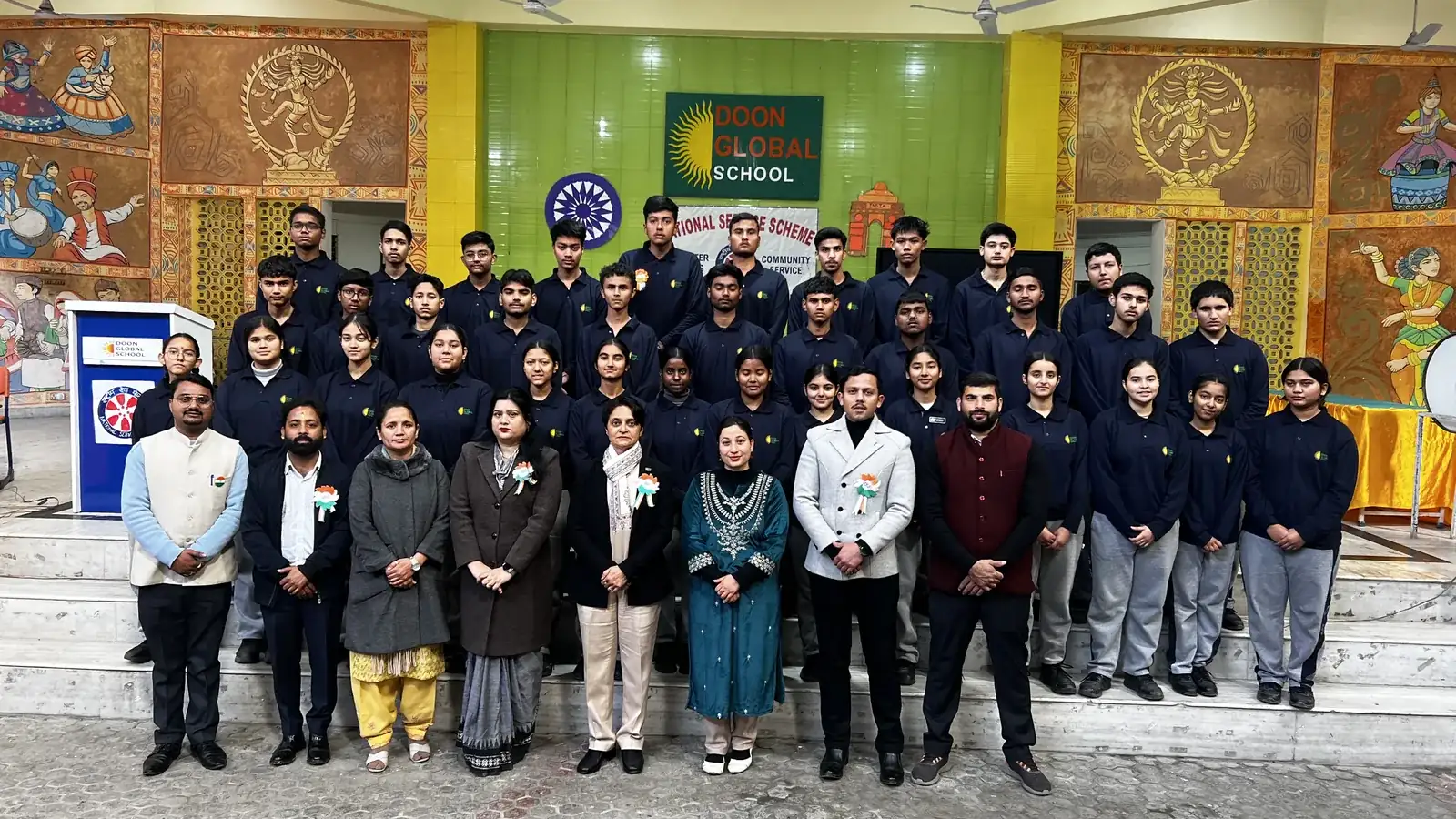
The photograph at the top of this article shows senior students and teachers at Doon Global School on Republic Day 2026. Republic Day marks 26 January 1950, the day the Constitution came into force. Students who want to study the subject in depth can take Political Science in the Humanities stream in Classes 11 and 12, and families can read our guide to Class 11 admission in Dehradun.