
- India has promised 500 GW of power capacity from non-fossil sources by 2030 and net zero emissions by 2070, the targets announced at COP26 in November 2021.
- Half of India's installed power capacity came from non-fossil sources by June 2025, five years ahead of the 2030 goal in its climate pledge.
- Capacity is not the same as output: non-fossil sources produced 29.2 per cent of India's electricity in 2025-26, so storage and grids matter as much as new panels.
- PM Surya Ghar (rooftop solar for one crore homes), PM-KUSUM (solar pumps for farmers) and the National Green Hydrogen Mission are three of the main programmes.
- Students can help by saving electricity, learning how clean energy works and taking that knowledge home.
Think about how much electricity you use in a single day: lights, fans, a phone charger, perhaps a computer for homework. Most of that power still comes from fossil fuels, which produced about 71 per cent of India's electricity in 2025-26. Burning them pollutes the air and releases the greenhouse gases that warm the planet. That is why green energy in India has become a national mission.
Solar panels on rooftops, wind turbines on open land and solar pumps on farms are changing where the country's power comes from, and green hydrogen could help clean up industry and transport. This guide explains what green energy is, what India has promised, how far it has come, what still stands in the way, and how students can help.
What Is Green Energy?
Green energy is power made from sources that nature keeps renewing, such as sunlight, wind, flowing water and plant matter, with far lower greenhouse gas emissions than coal, oil or gas. Coal and oil took millions of years to form and will run out; the sun will rise again tomorrow. The main sources are:
- Solar energy: sunlight turned into electricity by solar panels, on rooftops or in large solar parks.
- Wind energy: electricity made by wind turbines.
- Hydropower: electricity from flowing water, from large dams down to small hydro plants on hill streams.
- Bioenergy: power and fuel made from crop waste, plant matter and other organic waste.
Green hydrogen is not a source of energy but a clean fuel, made by splitting water with renewable electricity. India's National Green Hydrogen Mission expects it to help cut emissions in industry, transport and the energy sector.
India's targets often say non-fossil rather than renewable. Non-fossil covers the renewable sources plus nuclear power, which burns no coal, oil or gas but is not renewable. That is why official figures add nuclear to renewables when they measure progress towards the 2030 goal. On 31 March 2026 the totals stood like this:
| Source | Installed capacity, 31 March 2026 |
|---|---|
| Solar power | 150.26 GW |
| Wind power | 56.09 GW |
| Large hydro | 51.41 GW |
| Bioenergy | 11.75 GW |
| Small hydro | 5.17 GW |
| Renewable energy, total | 274.68 GW |
| Nuclear power | 8.78 GW |
| Non-fossil, total | 283.46 GW |
Source: Ministry of New and Renewable Energy, in a PIB release of 8 April 2026. One gigawatt (GW) is 1,000 megawatts.
The same release says India now ranks third in the world for installed renewable energy capacity, in the International Renewable Energy Agency's 2026 statistics (data to December 2025).
What Is India's Green Energy Mission?
There is no single scheme called the Green Energy Mission. The phrase describes a set of national targets and the programmes built to meet them.
The targets come from two places. At the COP26 climate summit in Glasgow on 1 November 2021, Prime Minister Narendra Modi set out five commitments, which he called the Panchamrit. They include 500 GW of non-fossil energy capacity by 2030, meeting 50 per cent of India's energy requirements from renewable energy by 2030, and net zero emissions by 2070. In August 2022 the Union Cabinet approved India's updated Nationally Determined Contribution, its formal pledge under the Paris Agreement. It commits India to cut the emissions intensity of its GDP (the emissions released for each unit of economic output) by 45 per cent from the 2005 level by 2030, and to reach about 50 per cent of installed power capacity from non-fossil sources by 2030.
| When | What happened |
|---|---|
| October 2015 | India's 2015 climate pledge (its Intended Nationally Determined Contribution): 40 per cent of power capacity from non-fossil sources by 2030 |
| November 2021 | COP26, Glasgow: 500 GW of non-fossil capacity by 2030 and net zero by 2070 announced |
| August 2022 | Updated pledge: emissions intensity 45 per cent below 2005 and about 50 per cent non-fossil capacity, both by 2030 |
| January 2023 | National Green Hydrogen Mission approved, with an initial outlay of ₹19,744 crore |
| February 2024 | PM Surya Ghar: Muft Bijli Yojana approved, with an outlay of ₹75,021 crore |
| June 2025 | Non-fossil sources reach 50.08 per cent of installed capacity, five years early |
| 2025-26 | 55.29 GW of non-fossil capacity added, the most in any single year |
| March 2026 | Non-fossil capacity reaches 283.46 GW |
Sources: the PIB releases listed under Sources below.
Half the Capacity, but Not Yet Half the Power
By June 2025 India had met the 2030 goal in its climate pledge: half of all installed power capacity was non-fossil. Yet in 2025-26 non-fossil sources produced 29.2 per cent of the electricity actually generated (538.97 of 1,845.92 billion units), the Ministry of New and Renewable Energy reported in April 2026.
The gap is not a mistake. Capacity tells you how much a power plant can produce at full output; generation tells you how much it really produced. A solar panel makes nothing at night and less on cloudy days, and wind turbines turn faster in some seasons than in others, while a coal plant can run day and night. So a gigawatt of solar produces far fewer units in a year than a gigawatt of coal. The share also changes through the day and the year: at one point in July 2025, renewables met 51.5 per cent of India's electricity demand of 203 GW, which the minister described as India's highest-ever renewable share.
This is why the next stage of India's transition is about storage and grids as much as new panels: batteries to keep the lights on after sunset, and transmission lines to carry power from sunny, windy states to the cities that use it.
6 Reasons Green Energy Matters for India
1. Cleaner Air and Better Health
Burning coal for power adds to the air pollution many Indian cities live with, along with vehicle exhaust, industry and construction dust. Clean electricity cannot fix pollution on its own, but every unit that comes from the sun or the wind instead of coal adds nothing to the smoke. The government lists reduced air pollution and better public health among the benefits India has already seen from clean energy.
2. Energy Security and Fewer Fuel Imports
India buys much of the oil and gas it uses from other countries, so a war or a price jump far away shows up in Indian fuel prices. Sunlight and wind are home-grown. The National Green Hydrogen Mission alone is expected to save over ₹1 lakh crore in total on fossil fuel imports by 2030, according to the Cabinet decision that approved it.
3. New Jobs and Factories
Clean energy has to be made, installed and maintained, and in a little over a decade India has built both the power plants and the factories that supply them:
| 2014 | 2026 | |
|---|---|---|
| Solar power installed | 2.82 GW | 150.26 GW |
| Wind power installed | 21.04 GW | 56.09 GW |
| All renewable energy installed (with large hydro) | 76.38 GW | 274.68 GW |
| Solar module factories (yearly capacity) | 2.3 GW | about 172 GW |
| Wind turbine factories (yearly capacity) | 10 GW | about 24 GW |
Installed capacity is at the end of March in each year; factory capacity is for 2014 and for 31 March 2026. Source: Ministry of New and Renewable Energy, in a PIB release of 8 April 2026.
Behind those numbers are engineers, electricians, solar technicians, factory workers, researchers and the small businesses that install and service equipment. For students, that means careers in solar and wind engineering, power systems, batteries and materials science, environmental science and energy finance. Our guide to career options beyond doctor, engineer and lawyer looks at many more.
4. Tackling Climate Change
Burning fossil fuels releases carbon dioxide, the main greenhouse gas behind global warming, which brings fiercer heat waves and less predictable rain. Cleaner electricity is central to India's pledge to reach net zero by 2070, but the work does not stop at power stations: transport, buildings, industry and farming all have to change too.
5. Innovation in Storage, Grids and Hydrogen
Green energy is more than panels and turbines. India has exempted the equipment for making lithium-ion battery cells for energy storage from basic customs duty until 31 March 2028, and the National Green Hydrogen Mission backs green hydrogen made in India. Smarter grids and electric vehicles are part of the same picture, and each is a field where today's students could be doing tomorrow's research.
6. Power and Income for Farmers and Villages
Clean energy is not only for cities. Under PM-KUSUM, the central government pays up to 30 or 50 per cent of the cost of a standalone solar pump (in place of a diesel pump) or of putting solar power on a farmer's existing grid-connected pump. Farmers can also set up solar power plants of up to 2 MW on barren or fallow land and sell the electricity to the local electricity company. In 2025-26 alone, 7.6 GW of solar capacity was installed under PM-KUSUM.
India's Main Green Energy Programmes
The Ministry of New and Renewable Energy names PM-KUSUM, PM Surya Ghar: Muft Bijli Yojana, solar park development and the National Wind-Solar Hybrid Policy among the flagship programmes behind the 50 per cent milestone. Two of them reach homes and farms most directly, and a third programme, the National Green Hydrogen Mission, is building a new industry:
| Programme | What it does | Scale |
|---|---|---|
| PM Surya Ghar: Muft Bijli Yojana | Subsidy and collateral-free loans for rooftop solar on homes | ₹75,021 crore; one crore households; up to 300 free units a month |
| PM-KUSUM | Subsidy for solar pumps; farmers can sell power from small solar plants on barren or fallow land | Up to 30 or 50 per cent of a pump's cost; plants of up to 2 MW; 7.6 GW installed in 2025-26 |
| National Green Hydrogen Mission | Capacity to make, use and export green hydrogen | At least 5 million tonnes a year by 2030; initial outlay ₹19,744 crore |
PM Surya Ghar: Muft Bijli Yojana
Launched on 13 February 2024 and approved by the Union Cabinet on 29 February 2024, it helps households put solar panels on their roofs with a subsidy and low-interest loans, and aims to give one crore homes up to 300 units of free electricity a month. A 3 kW rooftop system can generate more than 300 units a month on average, so it can also cut the electricity bill and let a family sell surplus power to the electricity company. Households apply through the national portal, pmsuryaghar.gov.in, which shows the scheme closing on 31 March 2027.
PM-KUSUM
The scheme's full name is Pradhan Mantri Kisan Urja Suraksha evam Utthan Mahabhiyan, and state government departments run it. It aims to take diesel out of farming and raise farmers' incomes in four ways: solar power plants on barren or fallow land, standalone solar pumps, solar power for existing grid-connected pumps, and solar power for whole agricultural feeders (the power lines that supply farm pumps).
National Green Hydrogen Mission
Approved on 4 January 2023, it aims to make India a global hub for producing, using and exporting green hydrogen. By 2030 it expects at least 5 million metric tonnes a year of green hydrogen production capacity, about 125 GW of linked renewable energy capacity, and a cut of nearly 50 million tonnes in annual greenhouse gas emissions.
What Stands in the Way?
India's progress is real, but the hardest parts of the transition are still ahead:
- Storage: solar and wind follow the weather, so power has to be stored for the evening peak and for cloudy, still days.
- Transmission: the best sun and wind are often far from the big cities, so new lines and substations are needed to carry the power.
- Upfront cost: panels, turbines, batteries and lines cost a great deal to build, even though the sunlight and wind are free afterwards.
- Land: large solar and wind farms need land, planned so that it does not come at the cost of farms or forests.
- Awareness: many families still do not know about rooftop solar support or how much electricity simple habits can save.
None of these is a reason to slow down. They are the problems the next generation of engineers, planners and citizens will be solving.
How Can Students Help?
Governments and companies build power plants, but every unit of electricity saved at home is a unit that never has to be generated. Students can:
- Switch off lights, fans and chargers when no one is using them.
- Read the electricity bill at home: find the units used this month and compare them with last month's.
- Learn how a solar panel, a wind turbine and a battery work, and build a model of one for a science exhibition.
- Join tree planting, clean-up and environment awareness drives.
- Carry a steel bottle and a cloth bag instead of buying single-use plastic.
- Share one energy-saving habit with the family every month.
Conclusion: A Cleaner Future Starts with Better Energy Choices
India has moved fast: half of its power capacity is already non-fossil, five years ahead of the date in its climate pledge. The harder part now is turning that capacity into clean power around the clock, with storage, stronger grids and new fuels such as green hydrogen. That will take engineers, scientists, entrepreneurs and informed citizens.
The future of energy is not only about producing more electricity. It is about producing it cleanly and using it wisely, and the second part starts at home.
Sources
Every figure in this article was checked against the source it comes from on 13 November 2026. Where a figure changes over time, the article gives the date it describes.
| What the article says | Source |
|---|---|
| India's targets of 500 GW of non-fossil capacity by 2030 and net zero by 2070 (COP26, 1 November 2021) | PIB: National Statement by the Prime Minister at COP26, 1 Nov 2021 |
| The 2015 pledge (submitted 2 October 2015) of 40 per cent non-fossil capacity; the updated 2022 pledge of a 45 per cent cut in emissions intensity and about 50 per cent non-fossil capacity by 2030 | PIB: Cabinet approves India's Updated Nationally Determined Contribution, 3 Aug 2022 |
| National Green Hydrogen Mission: ₹19,744 crore outlay, 5 million tonnes a year by 2030, about 125 GW of linked renewable capacity, nearly 50 million tonnes of emissions avoided a year, a cumulative saving of over ₹1 lakh crore on fossil fuel imports, emission cuts in industry, transport and energy | PIB: Cabinet approves National Green Hydrogen Mission, 4 Jan 2023 |
| PM Surya Ghar: ₹75,021 crore, one crore households, up to 300 free units a month, launched 13 February 2024, a 3 kW system makes over 300 units a month | PIB: Cabinet approves PM-Surya Ghar: Muft Bijli Yojana, 29 Feb 2024 |
| Non-fossil sources reached 50.08 per cent of installed capacity on 30 June 2025; the benefits seen and the flagship programmes named | PIB: India's Renewable Rise, 14 Jul 2025 |
| Capacity on 31 March 2026 by source and in March 2014; 55.29 GW added in 2025-26; non-fossil sources 29.2 per cent of generation in 2025-26 (so fossil fuels about 71 per cent); 51.5 per cent of demand in July 2025; third in the world; solar module and wind turbine factory capacity in 2014 and 2026; the customs duty exemption for lithium-ion battery-cell equipment to 31 March 2028; 7.6 GW under PM-KUSUM | PIB: India ranks third globally in renewable energy installed capacity, 8 Apr 2026 |
| What PM-KUSUM covers: subsidy of up to 30 or 50 per cent on standalone solar pumps and on solarising existing grid-connected pumps; farmers' solar plants of up to 2 MW on barren or fallow land; solarising feeders; run by state government departments | PM-KUSUM national portal, Ministry of New and Renewable Energy |
| How households apply for rooftop solar; the scheme closes on 31 March 2027 | PM Surya Ghar national portal |
Frequently Asked Questions
What is India's green energy mission?
There is no single scheme by that name. The phrase describes India's push to replace fossil fuels with clean energy: the national targets of 500 GW of non-fossil power capacity by 2030 and net zero emissions by 2070, and the programmes that serve them, such as PM Surya Ghar, PM-KUSUM and the National Green Hydrogen Mission.
What is India's renewable energy target for 2030?
India aims for 500 GW of installed electricity capacity from non-fossil sources by 2030, a goal announced at COP26 in 2021. Its updated climate pledge also set about 50 per cent of installed power capacity from non-fossil sources by 2030, and India reached that in June 2025.
How much renewable energy capacity does India have?
On 31 March 2026 India had 274.68 GW of renewable capacity, including 150.26 GW of solar, 56.09 GW of wind and 51.41 GW of large hydro. With 8.78 GW of nuclear power, total non-fossil capacity was 283.46 GW.
Why does India still use so much coal?
Because capacity is not the same as output. Non-fossil sources make up half of India's installed capacity, but they produced 29.2 per cent of its electricity in 2025-26, since solar panels stop at night and the wind changes with the seasons. More storage and transmission should raise that share.
What is the National Green Hydrogen Mission?
Approved in January 2023 with an initial outlay of ₹19,744 crore, it aims to make India a global hub for producing, using and exporting green hydrogen, with at least 5 million metric tonnes a year of production capacity by 2030.
How can students help India's green energy goals?
By saving electricity at home and at school, learning how solar panels, wind turbines and batteries work, joining environment activities, avoiding single-use plastic and sharing what they learn with their families.
Learning About Energy and the Environment at Doon Global School
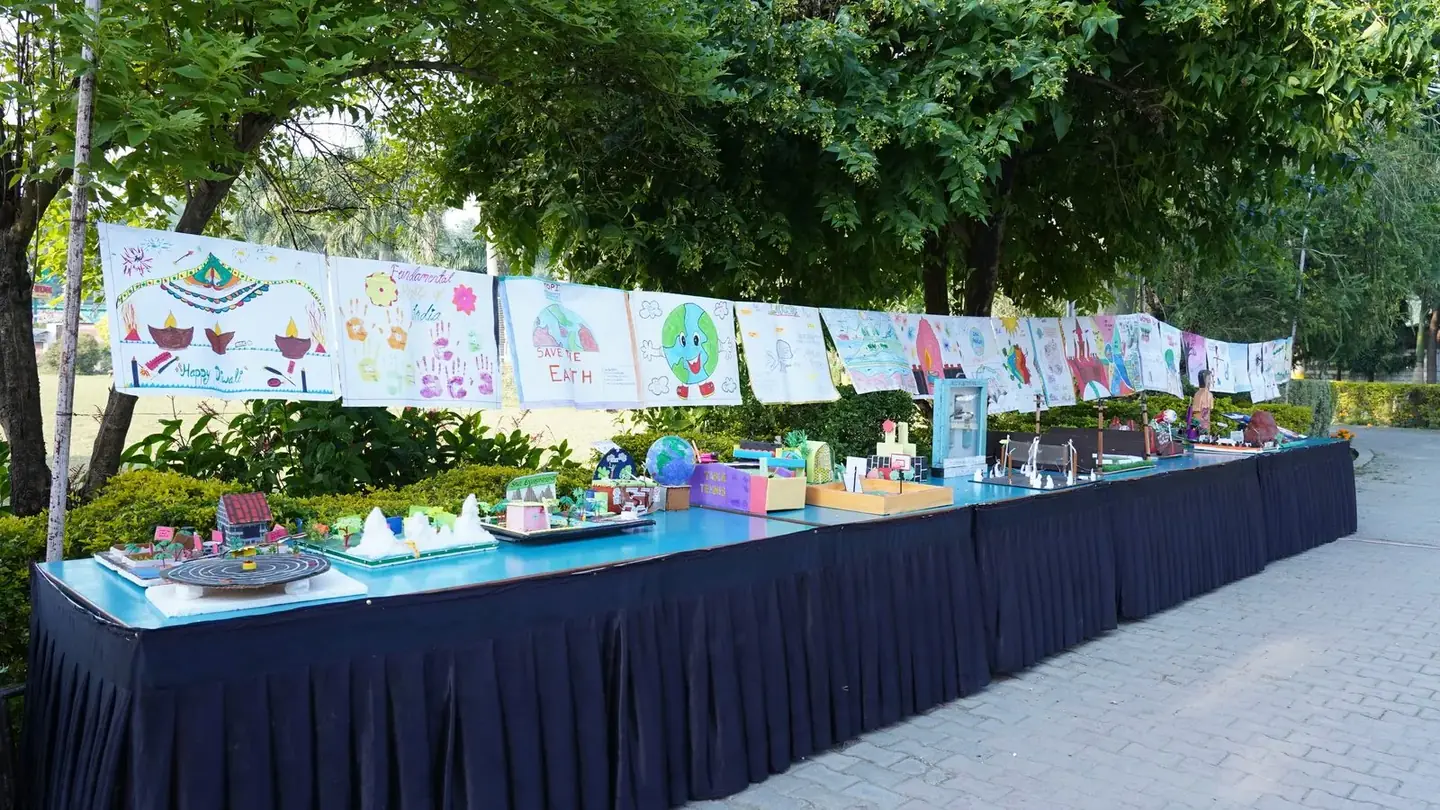
Doon Global School is a CBSE school in Dehradun (affiliation 3530108) on a 26,510 square metre campus at Jhajra, and the photographs in this article were taken there: the trees and lawn in front of the hostel block, and a student exhibition of posters and models. The school's published materials mention science, coding and robotics activities alongside the CBSE curriculum (see all-round development at DGS). From the 2027-28 session the school plans Pathfinders for Grades VI and VII, with science investigations and maths labs every fortnight.
About this article: This guide was written from a draft supplied by Doon Global School. The school's website team rewrote it, checked every figure against the Government of India sources in the table above, rewrote the questions and answers, and added the tables and this section. The cover is an illustration made for the school, not a photograph of the campus.